admin
admin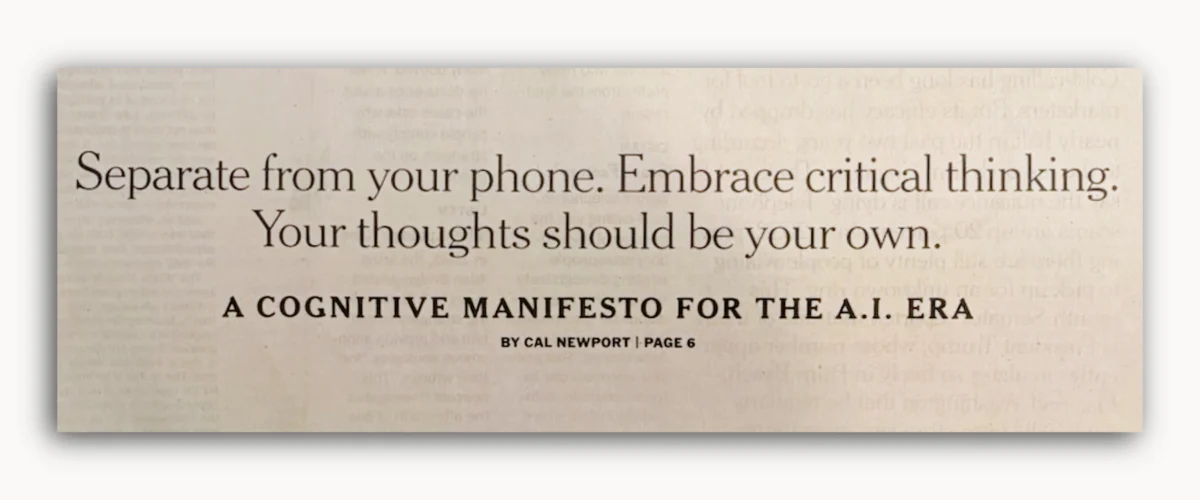
The landscape of modern knowledge work has undergone a seismic shift since the 2016 publication of Deep Work: Rules for Focused Success in a Distracted World. Author and Georgetown University computer science professor Cal Newport recently marked the tenth anniversary of the book’s conceptualization by reflecting on its enduring relevance and the deteriorating state of human attention. What began as an idiosyncratic exploration of the economic and philosophical value of concentration has evolved into a global movement, yet Newport warns that the challenges facing the "cubicle class" have transitioned from a struggle for time to a fundamental crisis of cognitive capacity.
When Deep Work was first released, the primary concern for professionals was the management of burgeoning digital interruptions. A decade later, the emergence of instant messaging platforms, low-friction video conferencing, and algorithmic social media has created an environment Newport describes as a "TikTok-ified slurry of optimized brain rot." In a recent long-form essay for the New York Times, Newport argued that the society-wide ability to engage in sustained, difficult thought is at risk of permanent erosion. This assessment comes as the book surpasses two million copies sold in over forty-five languages, signaling a desperate global appetite for strategies to reclaim mental autonomy.
The Economic and Philosophical Foundations of Focus
The genesis of Newport’s philosophy was rooted in a concept he termed "Moneyball for the cubicle class." Much like the data-driven revolution in professional baseball, Newport hypothesized that organizations were systematically undervaluing the rare and valuable commodity of deep focus. He defined "deep work" as professional activities performed in a state of distraction-free concentration that push cognitive capabilities to their limit, thereby creating new value, improving skill, and making efforts hard to replicate.
Conversely, "shallow work" was defined as non-cognitively demanding, logistical-style tasks, often performed while distracted. Newport’s thesis posited that as the economy became increasingly complex and dependent on high-level problem solving, the few individuals who cultivated the ability to work deeply would gain a massive competitive advantage.
Beyond the economic utility, the book delved into the philosophical necessity of focus. Drawing on the experiences of figures such as psychiatrist Carl Jung—who built a stone tower in the woods to escape the influence of Sigmund Freud—and contemporary blacksmiths using ancient techniques, Newport argued that the act of thinking is the core of the post-Paleolithic human experience. He suggested that deep work is not merely a tool for productivity but a source of profound satisfaction and "transcendence" in an era otherwise characterized by fragmented attention.
A Chronology of Declining Attention (2012–2026)
The trajectory of Newport’s work mirrors the rapid evolution of digital communication technology over the last fourteen years. This timeline illustrates the shift from optimistic connectivity to the current state of cognitive overload:
- 2012: Newport publishes So Good They Can’t Ignore You, arguing that "passion" is a byproduct of mastery and focus, rather than a prerequisite for a career.
- 2016: Deep Work is released. At this time, Slack was in its infancy for many firms, and Zoom was not yet a household name. The primary distractions were email and general web surfing.
- 2019: Digital Minimalism is published, addressing the rise of social media as a dominant force in personal life and advocating for a philosophy of technology use based on values rather than convenience.
- 2021: A World Without Email identifies the "Hyperactive Hive Mind" workflow, where constant communication via tools like Slack and Microsoft Teams replaces structured processes.
- 2024: Slow Productivity introduces a framework for sustainable achievement, reacting to the burnout caused by "pseudo-productivity" or the visible display of activity.
- 2026: Newport publishes a retrospective in the New York Times, declaring that the "cognitive shallows" have become a pervasive reality and calling for a "revolution in defense of thinking."
Supporting Data: The High Cost of the Hyperactive Hive Mind
The concerns raised by Newport are supported by a growing body of empirical data regarding the cost of task-switching and digital distraction. Research from the University of California, Irvine, led by informatics professor Gloria Mark, has tracked the decline of the average attention span on a computer screen. In 2004, the average time spent on a single task before switching was 150 seconds. By 2012, it had dropped to 75 seconds, and recent studies suggest it now averages roughly 47 seconds.
Furthermore, the phenomenon of "attention residue," a term coined by business professor Sophie Leroy, explains why frequent interruptions are so damaging. When a worker switches from Task A to Task B, a portion of their cognitive resources remains stuck on Task A. This means that even if a worker "just checks" a Slack notification for 10 seconds, their performance on their primary task is degraded for several minutes afterward.
The economic impact is equally staggering. According to data from the software company RescueTime, the average knowledge worker checks communication tools every six minutes. This constant state of fragmentation prevents the brain from entering the "flow state" required for complex synthesis and creative breakthroughs. The rise of generative AI has added a new layer to this dilemma; while these tools offer shortcuts for content creation, Newport suggests they may further atrophy the human "muscles" required for original thought.
Industry Reactions and the Institutional Response
The response to the "deep work" deficit has been varied across sectors. In the technology industry, some firms have experimented with "No-Meeting Wednesdays" or "Deep Work Wednesdays" to provide employees with uninterrupted blocks of time. However, these top-down initiatives often struggle against the cultural gravity of the "always-on" expectation.
Academic circles have been more vocal about the long-term implications for education. Dr. Maryanne Wolf, a developmental psychologist and author of Reader, Come Home, has expressed concerns similar to Newport’s regarding the "bi-literate brain." She notes that the constant scanning and skimming encouraged by digital platforms are eroding the "deep reading" processes—such as critical analysis and empathy—that take time to develop in the brain’s circuitry.
In the corporate world, the reaction is often polarized. While executives acknowledge the value of high-level strategy, the infrastructure of the modern office—characterized by open-plan layouts and "presence" indicators on messaging apps—continues to prioritize accessibility over depth. Newport’s call for a revolution suggests that individual willpower is no longer sufficient; instead, a structural overhaul of how work is assigned and measured is required.
The Manifesto: A Revolution in Defense of Thinking
In his latest writings, Newport moves beyond the "tips and tricks" of productivity to propose a more radical stance. He argues that the current state of work is not just inefficient but inhumane, as it denies individuals the opportunity to use their brains to their full potential.
The proposed "Revolution in Defense of Thinking" includes several concrete pillars:
- The Rejection of Hyper-Accessibility: Shifting the cultural norm from "instant response" to "asynchronous reliability." This involves moving away from the expectation that an employee should be reachable at all times of the work day.
- The Valorization of Cognitive Endurance: Treating the ability to focus as a skill to be trained, much like athletic performance, rather than a fixed trait.
- Structural Workflow Redesign: Implementing systems where work is pushed to individuals in a controlled manner, rather than allowing a chaotic stream of requests to dictate a person’s schedule.
- Analog Resistance: Reincorporating non-digital tools—such as notebooks, physical libraries, and "quiet hours"—into the professional environment to mitigate the pull of algorithmic distraction.
Newport’s conclusion in his recent New York Times op-ed serves as a rallying cry for this movement. He asserts that he is "done ceding my brain… to the financial interests of a small number of technology billionaires or the shortsighted conveniences of hyperactive communication styles."
Broader Impact and Future Implications
The implications of Newport’s work extend far beyond individual productivity. On a macroeconomic scale, the ability of a nation’s workforce to engage in deep work may determine its capacity for innovation in fields like biotechnology, engineering, and artificial intelligence. If the workforce is trapped in a cycle of shallow administrative maintenance, the rate of fundamental discovery is likely to slow.
Societally, the erosion of focus has implications for civic discourse and mental health. A population unable to focus on long-form arguments or complex historical contexts is more susceptible to the short-form emotional manipulation prevalent on modern social platforms. Newport’s "revolution" is, therefore, as much a defense of the democratic intellect as it is a professional strategy.
As Deep Work enters its second decade, it remains a foundational text for a world that is increasingly "connected" yet arguably less thoughtful. The success of the book suggests that while the technology for distraction has become more sophisticated, the human desire for meaningful, concentrated effort remains unchanged. The coming years will likely determine whether the "cognitive shallows" become a permanent feature of human existence or if a new generation of workers will successfully stage the revolution Newport envisions, reclaiming the "post-Paleolithic human experience" of deep, transformative thought.