admin
admin
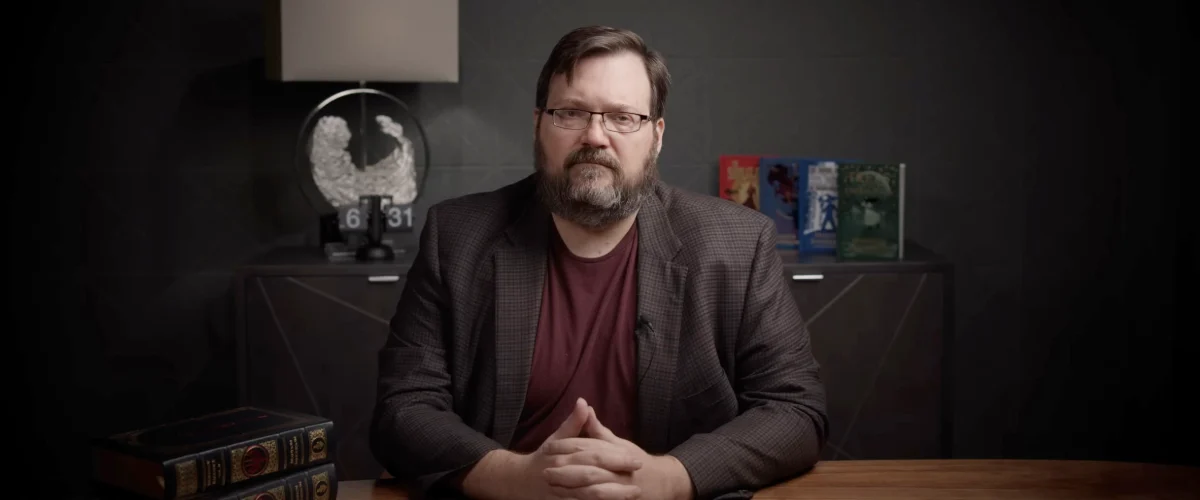
The rapid evolution of generative artificial intelligence has prompted a significant cultural and philosophical debate regarding the nature of artistic creation, the value of human effort, and the future of intellectual property. At the center of this discourse is Brandon Sanderson, a preeminent figure in modern fantasy literature, who recently addressed these concerns during the Dragonsteel Nexus conference. His speech, titled The Hidden Cost of AI Art, serves as a cornerstone for a growing movement of creators who are transitioning from passive observation of technological advancement to an active reassertion of human agency. This shift comes at a critical juncture for the creative industries, as large language models (LLMs) and image generators move from experimental novelties to integrated tools in professional workflows.
The Dragonsteel Nexus Address and the Philosophy of Process
Dragonsteel Nexus, an annual convention organized by Sanderson’s media company, Dragonsteel, serves as a focal point for tens of thousands of readers and creators within the "Cosmere" fandom. It was in this setting that Sanderson articulated a nuanced critique of generative AI, focusing not merely on the legalities of data scraping or the threat to livelihoods, but on the fundamental purpose of the creative act. Sanderson’s position is defined by a distinction between art as a final product and art as a transformative process.
During his address, Sanderson acknowledged the technical fascination surrounding LLMs but expressed a visceral discomfort with their application in creative fields. He systematically examined common objections to AI—such as the "theft" of training data or the potential for job displacement—before identifying his primary concern: the erosion of the human experience inherent in creation. Sanderson argued that the value of his early, unpublished manuscripts did not lie in their marketability or their quality as a product, but in the internal growth he experienced while writing them. For Sanderson, the act of completing a complex project is a "transcendent moment" of personal accomplishment that an algorithmic output cannot replicate, regardless of the quality of the generated text.
This perspective challenges the "product-centric" model of the tech industry. In this model, the efficiency of generating a 100,000-word manuscript is prioritized over the years of cognitive development and skill acquisition required for a human to produce the same work. Sanderson’s argument suggests that by delegating the struggle of creation to a machine, the individual loses the very benefit that makes art a worthwhile human endeavor.
Art as Cognitive Communication and the Telepathy Model
Building upon Sanderson’s philosophical foundation, contemporary analysis has expanded the definition of art to include the concept of "deep human communication." This theory posits that art serves as a tangible medium—whether it be prose, paint, or music—used to transmit a complex internal cognitive state from the mind of the creator to the mind of the audience. This "telepathic" exchange is viewed as a uniquely human capability, grounded in shared biological and emotional experiences.
When a reader engages with a novel, they are not merely consuming information; they are participating in a bridge built by another human being. From this viewpoint, a book written by a language model or a film generated by a prompt is perceived as fundamentally hollow. Critics of AI-generated content argue that because a machine lacks a subjective internal state, it cannot "communicate" in any meaningful sense. It can only simulate the patterns of previous human communication. This has led to the comparison of AI art to a "quixotic simulation of love"—a synthetic experience that mimics the external markers of a human connection without the underlying reality.
The Technological Context: Capabilities and Vulnerabilities of LLMs
The debate over AI art does not exist in a vacuum; it is driven by the staggering technical leaps made by companies such as OpenAI, Anthropic, and Google. To understand the scale of the challenge facing human creators, one must look at the data regarding the capabilities of these models. For instance, Anthropic’s Opus 4.6, a highly advanced LLM, has demonstrated utility far beyond creative writing, extending into the realms of cybersecurity and complex problem-solving.
In supplementary release notes and technical reports, Anthropic revealed that Opus 4.6 was utilized by researchers to identify high-severity vulnerabilities in software. The model reportedly found and validated more than 500 high-severity "zero-day" vulnerabilities, some of which had remained undetected in codebases for decades. This data highlights the dual-use nature of generative AI. While the same technology can be used to generate a fantasy story, its primary strength lies in pattern recognition and the synthesis of vast datasets.
The fact that an AI can outperform human experts in identifying technical flaws underscores why many creators feel a sense of "nihilistic passivity." If a machine can solve decades-old engineering problems in seconds, the assumption follows that it will eventually master the nuances of plot, character, and prose. However, the distinction remains that while a zero-day vulnerability is a factual, objective flaw in logic, art is a subjective expression of the human condition—a distinction that technical metrics often fail to capture.
Chronology of the AI Creative Crisis
The current tension between the tech sector and the creative community has developed over a series of key milestones:
- Late 2022: The public release of ChatGPT and high-quality image generators like Midjourney sparks initial alarm among illustrators and writers.
- Early 2023: Lawsuits are filed by artists and stock photo agencies against AI companies, alleging copyright infringement via the unauthorized use of training data.
- Mid-2023: The WGA and SAG-AFTRA strikes in Hollywood bring AI concerns to the forefront of labor negotiations, resulting in new protections for human writers and actors.
- Late 2023: Brandon Sanderson delivers his "Hidden Cost of AI Art" talk, shifting the conversation from legal protection to philosophical resistance.
- 2024: Companies like Anthropic release increasingly powerful models (e.g., the Opus series), demonstrating the accelerating pace of AI development and its ability to perform "expert-level" tasks.
This timeline illustrates a shift from technical novelty to a structural challenge to human labor and expression. Each advancement in model capability has been met with a corresponding pushback from human creators seeking to define the boundaries of "meaningful" work.
Industry Reactions and the Rejection of Nihilism
The reaction to Sanderson’s address and the broader AI movement has been polarized. On one side, tech evangelists and some industry analysts argue that AI will democratize creativity, allowing those without technical skills (such as drawing or coding) to bring their visions to life. They view the AI as a "co-pilot" that handles the drudgery of production.
On the other side, a growing number of writers, artists, and cultural critics are pushing back against what they call "nihilistic passivity." This term describes a trend in modern commentary where authors outline grim, AI-dominated futures and conclude that such outcomes are inevitable. Sanderson’s conclusion—that humans have the agency to simply say "no"—has resonated as a call to action.
This sentiment is echoed in the "human-made" movement, where creators and publishers are beginning to use certifications or labels to guarantee that no generative AI was used in the production of a work. The argument is that if art is a human-defined concept, then the market for art will ultimately be determined by what humans value. If the public continues to value the "telepathic" connection of human-to-human communication, then the "manuscripts piled to the pillars of heaven" by machines will remain economically and culturally secondary.
Broader Implications: Agency and the Future of Meaning
The implications of this debate extend far beyond the publishing industry. They touch upon the core of how society values labor and achievement. If the "sweet, beautiful, and transcendent" moment of finishing a difficult task is replaced by a button-click, the psychological impact on human development could be profound.
Sanderson’s stance serves as a reminder that technological "progress" is not an autonomous force of nature; it is shaped by human choices, consumer habits, and social norms. The determination of what constitutes "real" art lies not with the developers at OpenAI or Anthropic, but with the audience and the creators themselves.
As AI models continue to find vulnerabilities in software and generate increasingly sophisticated content, the human element becomes a premium. The future of the creative economy may not be a battle of "Man vs. Machine" in terms of output volume, but rather a re-evaluation of what is "sacred" in the human experience. By asserting agency and refusing to accept a passive role in the face of automation, figures like Sanderson are advocating for a future where technology serves human flourishing without cannibalizing the very processes that make us human.
In conclusion, the "hidden cost" of AI art is the potential loss of the transformative struggle that defines the artist. As the machines continue to produce at an infinite scale, the human response—characterized by a deliberate choice to value the difficult, the personal, and the manual—will likely become the defining cultural struggle of the 21st century. The power to define art, and by extension, the meaning of human effort, remains firmly in human hands, provided those hands are willing to hold onto the "sweet and beautiful" difficulty of creation.