admin
admin
A recent personal health scare, initially mistaken for a cardiac event, has illuminated the pervasive and often unrecognized phenomenon of vicarious trauma, a profound psychological and physiological response to prolonged exposure to the suffering of others. This experience, recounted by a prominent mindfulness educator, underscores a growing public health concern in an era of relentless global crises and instantaneous digital information dissemination. The narrative serves as a stark reminder that the weight of collective suffering can manifest in severe physical and emotional symptoms, challenging individuals to re-evaluate their engagement with the world and cultivate sustainable strategies for well-being and effective action.
The Personal Catalyst: When Empathy Manifests as Physical Distress
Three weeks prior, the individual, a seasoned mindfulness teacher accustomed to guiding thousands through stress-reduction techniques, found herself in an emergency room, convinced she was enduring a heart attack. The preceding days had been marked by alarming symptoms: persistent chest tightness, difficulty achieving a full breath, and radiating pain down her left shoulder. Despite her professional expertise in self-regulation, initial attempts to rationalize these symptoms — attributing them to strenuous gym workouts or awkward sleep — proved futile. She maintained her demanding routine of meditation, teaching, and holding space for others, attempting to "breathe through" the discomfort as she had instructed countless students. However, the unyielding pain on a Sunday, coupled with the closure of her doctor’s office, prompted her husband to intervene decisively: "We’re going to the ER."
Five hours of diagnostic tests and anxious waiting later, the cardiologist delivered the reassuring news: her heart was healthy. While a wave of gratitude was immediate, it was swiftly followed by confusion. If her cardiovascular system was robust, what profound message was her body attempting to convey? This pivotal moment initiated a deeper inquiry into the subtle yet potent ways our interconnectedness with global suffering can impact personal health, leading to the identification of vicarious trauma as the likely culprit. This initial medical crisis, therefore, transformed from a personal ailment into a diagnostic lens for a broader societal affliction.

Unveiling Vicarious Trauma: The Unseen Burden of Bearing Witness
The individual’s experience is far from isolated. Mental health professionals and researchers increasingly recognize that if one has been attentive to global events over recent months, they are likely carrying a heavier burden than they realize. This silent burden has a name: vicarious trauma, also known as secondary trauma or compassion fatigue. It refers to the psychological and physiological impact of sustained empathic engagement with others’ pain, particularly when exposure is continuous and overwhelming.
In our hyper-connected world, the distinction between direct experience and absorbed experience through media has blurred significantly. Images of devastation from conflicts in Gaza, reports of Israeli families living under constant threat, escalating political violence and enforcement actions within domestic borders, and the rise of Islamophobia and antisemitism fracturing communities are not merely news items; they are deeply affecting stimuli. Furthermore, the countless narratives of Black, Indigenous, and other people of color whose deaths often go unacknowledged by mainstream media, alongside ongoing humanitarian crises in regions like Sudan, Yemen, and Iran, where suffering persists largely outside sustained media attention, collectively contribute to this empathic overload.
The witnessing of such widespread suffering is relentless. Each morning, news feeds and social media platforms deliver new stories, new graphic images, and fresh reasons for alarm or heartbreak. Even when individuals are not directly affected by these events, their nervous systems are constantly processing this influx of distressing information. Research indicates that prolonged exposure to suffering, particularly through visual and narrative media, can activate similar neurological pathways to those experienced during direct trauma. The brain does not always differentiate effectively between personally experienced threat and empathetically absorbed threat, leading to a state of chronic activation.
Mental health experts, such as Dr. Charles Figley, a pioneer in the study of compassion fatigue, highlight that symptoms often include feeling unusually tense, exhausted, reactive, numb, or an inability to disengage—even when a break is desired. Such responses are not indicative of a personal failing but rather a natural, albeit taxing, reaction to sustained empathic engagement with intense suffering. According to a 2022 study published in the Journal of Traumatic Stress, frontline workers, journalists, and even the general public who consume high levels of news about traumatic events report significantly higher rates of anxiety, depression, and post-traumatic stress symptoms. The impact extends beyond mental health, manifesting physically, as exemplified by the initial heart attack scare, often leading to increased emergency room visits for stress-related somatic complaints.

The Duality of Response: Engagement Versus Withdrawal
Vicarious trauma manifests in diverse ways, often leading to two primary, yet equally detrimental, coping mechanisms: over-engagement or withdrawal. For some, the constant stream of suffering creates an overwhelming sense of moral urgency, compelling them to remain perpetually informed and actively engaged. While "staying informed matters" and "bearing witness matters," this exposure without the capacity to adequately process the emotional and psychological intake carries significant consequences, often operating beneath conscious awareness. This relentless engagement can lead to burnout, chronic stress, and a state of hyper-reactivity, where the nervous system remains in a constant state of alert.
Conversely, for others, the sheer volume and intensity of suffering can feel paralyzing or futile, prompting a retreat into disengagement. This might involve scrolling past distressing headlines, actively turning off news broadcasts, or rationalizing a need to focus solely on personal life. While discerning moments for rest, setting healthy boundaries, and practicing self-care are undoubtedly crucial, when disconnection becomes the primary response to vicarious trauma, something more profound erodes. Many disengage not due to a lack of empathy, but from an overwhelming sense of powerlessness, grappling with the question, "What difference could I possibly make?" In the face of global crises of immense scale, individual action can appear insignificant, even naive, leading to a feeling that shutting down is the only viable survival mechanism.
However, in an increasingly interconnected world, complete disconnection is an illusion. Prolonged disengagement results in more than just a loss of information; it fosters a loss of contact – contact with unfolding realities, with one’s core values, and with the small but meaningful avenues through which care can be extended. What begins as a protective measure can subtly evolve into a profound loss of agency and connection, both with the world and with one’s authentic self.
Research consistently shows that vicarious trauma disrupts fundamental beliefs about safety, trust, control, intimacy, and meaning. It permeates cognitive processes, emotional states, physical well-being, and behavioral patterns. Common reports from individuals experiencing vicarious trauma include heightened anxiety, irritability, difficulty concentrating, sleep disturbances, intrusive thoughts, and a general sense of hopelessness. And, as the initial anecdote illustrates, it can indeed lead to emergency room visits for unexplained physical ailments.

More subtly, yet more consequentially, vicrasious trauma represents a loss of contact with our inherent capacity to respond skillfully. When caught in default patterns of over-consumption or withdrawal, individuals lose touch with their body’s intelligence, their intuitive sense of what is genuinely needed, their agency beyond mere outrage or resignation, their ability to discern where their care is most effective, and their capacity to maintain humanity without hardening. This is not merely trauma; it is a profound disconnect from our essential humanness. As the mindfulness educator aptly notes, "Oppressive systems don’t need to silence us when exhaustion and reactivity will do the job for them." The resulting loss of contact inevitably leads to diminished connection with others, with purpose, and with the inner wisdom required for wise and effective action.
Eroding Collective Capacity: The Threat to Social Movements
When this loss of contact occurs on a large scale, the implications for collective action and social change are severe. Social movements can fracture, allies may turn against one another, and nuanced perspectives are often misconstrued as betrayal. Strategic thinking frequently gives way to moral reflex, and the very capacities essential for sustained, impactful change—such as discernment, patience, and relational trust—begin to erode.
This diminished capacity extends beyond personal well-being, directly impacting our ability to collaborate effectively. When individuals lose touch with their discernment, a pervasive sense of threat can emerge, leading to suspicion and animosity even within allied groups. The act of listening to differing perspectives can be perceived as a moral failure, and intensity of emotion is often mistaken for genuine impact, while urgency overshadows wisdom.
The author recounts personal instances of this phenomenon: being publicly attacked online for attempting to navigate complex issues with nuance, rather than adopting a singular, polarized stance. Accusations of complicity and questioning of integrity were common. However, by practicing inner calm and compassion, the author was able to maintain contact with her core values of deep listening and understanding. This approach led to a surprising outcome: the aggressor later apologized, attributing their harshness to exhaustion and overwhelm. This powerful exchange highlighted that the underlying suffering and vicarious trauma were real, and without tools for processing, that pain often externalizes as aggression.
Similarly, an attempt to draft a Town Council resolution that acknowledged both the need to end violence and legitimate security concerns on all sides was rejected. The issue was not disagreement with facts, but the collective inability to hold "both-and" perspectives in a state of widespread disconnection. This illustrates how movements can lose their strength not from fundamental disagreement on goals, but from operating out of disconnection rather than from the deeper wisdom that emerges from careful listening and inclusive problem-solving. Sustained change demands more than mere passion; it requires capacity—the ability to engage and withdraw judiciously, to remain open without collapsing, and to maintain connection with one another even amidst challenging work. Without this capacity, not only does effectiveness diminish, but the vital bonds of community and solidarity are also severed.
The Imperative of Rest and Skillful Practice
Amidst the overwhelming nature of vicarious trauma, the path to regaining contact and sustaining engagement lies in intentional rest and the cultivation of specific skills. The author shares a transformative personal experience: a simple dinner with friends, filled with easy conversation and board games. Initially, a wave of guilt washed over her, questioning the appropriateness of laughter and ease while so much suffering permeated the world. A fleeting irritation toward her companions surfaced, wondering if they simply didn’t care as deeply.
However, a moment of self-awareness allowed her to catch this unskillful judgment. She recognized that this guilt and criticism were isolating, detracting from her effectiveness and compassion. She made a conscious choice to be present, to savor the food, engage in playful banter, and allow the warmth of friendship to soften the rigidity that had settled within her. This seemingly simple act of restoration proved quietly liberating, enabling her to return to her work the next day with renewed energy, clarity, and steadiness. This was not an escape from reality, but a vital act of restoration.
Rest, in this context, is not a reward for work completed, but the foundational ground that enables sustained engagement. Gathering with others, not for organizing or persuading, but simply to share a meal, laugh, play, or enjoy company, is not an avoidance of responsibility. It is an act of restoring contact with the inherent aliveness that oppressive systems often seek to extinguish. These moments—a shared meal, engaging with music or art, a walk in nature—are not indulgent but essential for recalibrating the nervous system and reconnecting with the fundamental humanity that fuels compassionate action.
From this restored state, certain trainable skills become invaluable for maintaining contact when re-engaging with difficult realities. The author argues that traditional mindfulness, often focused solely on meditation and non-judging awareness, while necessary, is insufficient for navigating complex contemporary challenges. While calming the nervous system through meditation is a crucial first step, without additional skills, individuals often revert to default reactive patterns.
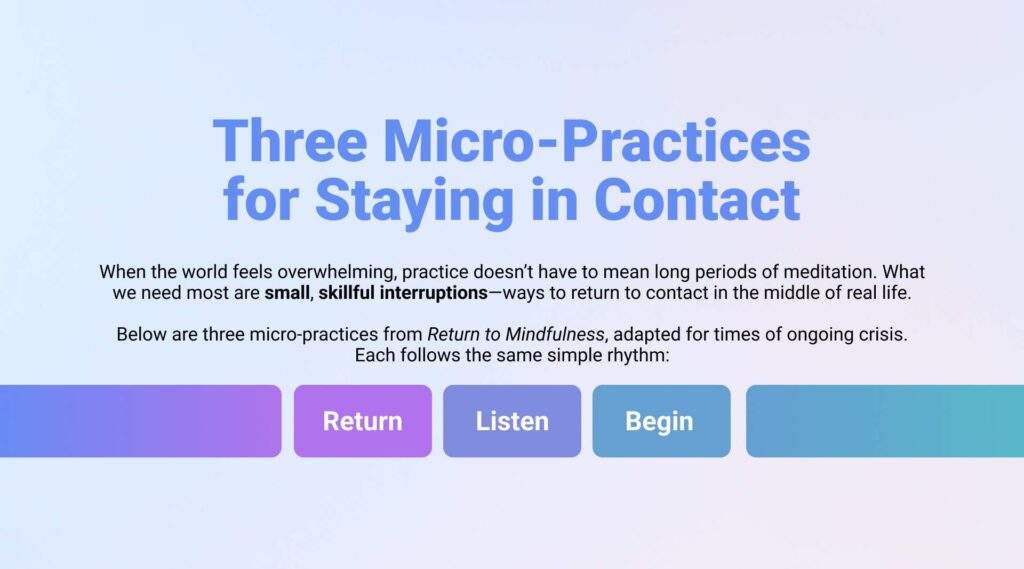
Drawing from early Buddhist teachings and contemporary psychology, the author identifies three particularly essential skills:
-
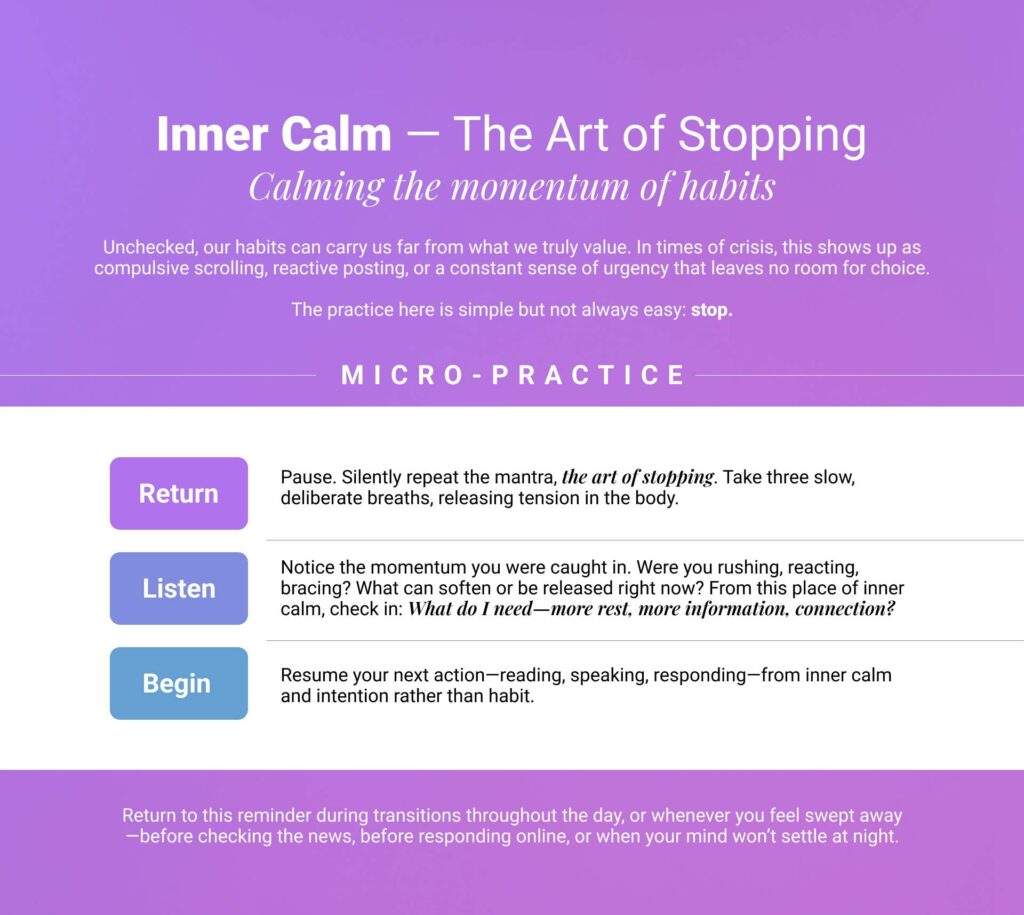
Inner Calm: This is the art of pausing, observing, and letting go for the purpose of healing and clarity. It involves softening the grip of habitual hurriedness, limiting beliefs, and expectations that disrupt inner equilibrium. Inner calm manifests as physical composure and mental tranquility, creating the necessary space to hold all experiences without attachment or resistance.
-
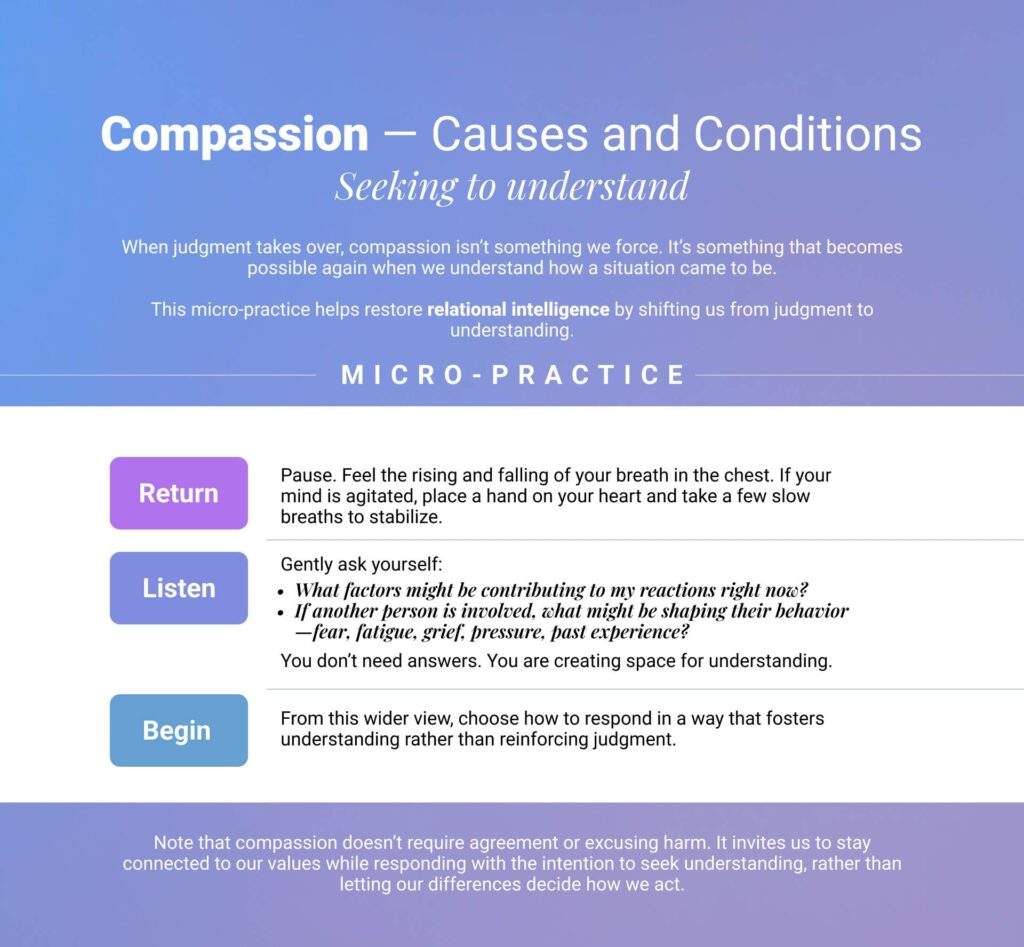
Compassion: This innate human capacity allows us to feel, understand, and be motivated to alleviate suffering in ourselves and others. It actively disrupts the tendency to act on automatic judgments, instead prompting a deeper quest for understanding. Without compassion, adversaries are seen as enemies rather than struggling fellow humans, and allies are criticized for perceived imperfections. This leads to a loss of relational intelligence—the ability to sense one’s impact on others and bridge differences.
-
Curiosity: This is the ability to maintain genuine interest and care, driven by a desire to understand situations fully, even when challenging. It actively counters confirmation bias by fostering openness and patience in the face of uncertainty and new information. Curiosity widens the narrow lens often imposed by trauma, restoring contact with complexity and facilitating the discernment of truly helpful responses. Its aim is not to be "right," but to be effective.
These three skills collectively interrupt default patterns of reactivity and withdrawal, reopening the channel between knowing what truly matters and being able to act upon it skillfully. The author emphasizes that skillful response is highly individualized, shaped by personal resources, capacity, and unique gifts. Whether it’s a parent raising children with the capacity for complexity, an artist creating work that processes grief, an organizer building coalitions, or a healer tending to those on the front lines, "there isn’t one right way to meet the darkness. Only many necessary ones."
In conclusion, the wisdom encapsulated in Michael Dubois’s poem, "When Things Feel Dark," resonates profoundly: the world needs more healers, helpers, artists, poets, radical resters, and warriors of peace. It needs individuals willing to learn from failure, to think, to thank, to forgive, and to build bridges. The world needs those who see the darkness precisely because they understand the imperative of turning on the light.
The journey from a personal health crisis to a deeper understanding of vicarious trauma and its societal implications culminates in an invitation to practice. This practice is not about achieving perfection but about consistently returning to what is already alive within us and offering that wisdom skillfully. The micro-practices of "Return, Listen, and Begin/Select" for fostering inner calm, compassion, and curiosity, serve as tangible steps toward navigating these challenging times. Ultimately, the message is one of courage to acknowledge when we’ve lost ourselves, the skill to return, and the trust that our unique contributions, offered wisely, are precisely what the world requires for collective healing and sustained change.