admin
admin
Inner calm, frequently perceived as a transient state of tranquility achieved after a yoga session or a relaxing massage, is, in fact, a profound and sustainable capacity for navigating life’s complexities with ease and clarity. Far from a mere absence of stress, it represents an individual’s developed ability to disengage from attachments and automatic reactions to external events, fostering a deep sense of equilibrium. This distinction is critical in understanding its broader implications for personal well-being and societal resilience.
The Foundational Principles: Mindfulness and Impermanence
At its core, inner calm is deeply intertwined with mindfulness, a skill that cultivates present-moment awareness without judgment. As a mindfulness skill, inner calm manifests as the capacity to release attachments and reactive patterns, stemming from a fundamental understanding of impermanence. This principle, central to many ancient wisdom traditions, acknowledges the ever-changing nature of thoughts, emotions, and desires. In moments of perceived urgency or heightened reactivity, the simple, yet profound, reminder – "This too shall pass" – serves not to negate the validity of one’s feelings but to introduce a crucial pause, applying a necessary brake to accelerated emotional responses. This pause allows for a return to an inner stillness, from which the true source and transient nature of reactivity can be observed, paving the way for liberation from its grip.
Historically, the concept of inner calm has been explored across diverse philosophical and spiritual traditions. From the Stoic emphasis on controlling one’s reactions rather than external events, to the Buddhist teachings on non-attachment and the impermanence of all phenomena (anicca), the pursuit of an undisturbed mind has been a consistent human endeavor. In contemporary psychology, these ancient insights are increasingly validated by scientific research, highlighting the neurobiological mechanisms through which mindfulness practices cultivate emotional regulation and cognitive flexibility. The modern re-framing of these concepts into accessible practices has led to a significant increase in public and professional interest, with mindfulness programs now integrated into corporate wellness, educational curricula, and clinical therapeutic interventions.
The Art of Stopping, Looking, and Letting Go
As a tangible practice, inner calm is the deliberate art of stopping, observing, and letting go. This deliberate process serves the dual purposes of healing and achieving clarity. It encompasses both physical composure, evidenced by relaxed muscles and an overall sense of ease in the body, and mental tranquility, characterized by a spaciousness in the mind that can hold experiences without attachment or resistance. Conversely, the absence of inner calm often manifests as physical restlessness, mental agitation, or pervasive reactivity, indicating a mind and body constantly at odds with their present reality. This state can be likened to a persistent internal struggle, draining vital energy and hindering optimal functioning.
The benefits of cultivating this state extend beyond individual peace. Research by institutions such as the American Psychological Association consistently links mindfulness and emotional regulation to improved physical health outcomes, including reduced blood pressure, enhanced immune function, and better sleep quality. Furthermore, studies on occupational stress demonstrate that employees trained in mindfulness report higher job satisfaction, reduced burnout, and improved interpersonal relationships at work, translating into tangible economic benefits through increased productivity and lower absenteeism.
The Paradox of Pursuit: Letting Go to Attain Calm

Ironically, the earnest pursuit of inner calm can often become an impediment to its attainment. True inner calm, a profound psychological paradox reveals, is achieved when one relinquishes the very desire for it, even the desire for calm itself. This "catch-22" phenomenon is vividly illustrated by the experience of a client grappling with anxiety, who turned to meditation hoping to alleviate his mental distress. Rather than finding solace, he reported an increase in anxiety post-meditation. His expectation that meditation would magically induce sleep was met with frustration as he observed his own restlessness during a body scan meditation, exacerbating his sleep problems.
The crucial lesson derived from such experiences is that peace is often found by first letting go of expectations surrounding its discovery. To achieve this letting go, the client learned to identify three common hindrances to mindfulness: a restless mind ("running in circles"), striving for a specific outcome ("pulling" to sleep), and frustration with the present reality ("pushing" against restlessness). Through consistent practice, he cultivated acceptance of his restless mind, which in turn softened his striving and frustration. This acceptance ultimately allowed him to find ease, even amidst sleeplessness, paradoxically enabling sleep to occur. This narrative underscores a fundamental principle in various therapeutic modalities, including Acceptance and Commitment Therapy (ACT), which posits that psychological flexibility and acceptance of internal experiences are key to well-being, rather than the elimination of discomfort.
The Neurobiology of Emotion: The Ninety-Second Rule and Amygdala Hijack
The cultivation of inner calm is not about suppressing, denying, or avoiding emotions. Instead, it involves cultivating the ability to remain present with unpleasant sensations, understanding that emotions are physiological responses with a finite lifespan. Neuroscientific insights, particularly the "ninety-second rule" popularized by neuroscientist Dr. Jill Bolte Taylor in her book My Stroke of Insight, illuminate this process. Dr. Taylor explains that the physiological arc of an emotion – its beginning, peak, and dissolution – typically lasts no more than ninety seconds. During this brief window, a chemical surge is released into the bloodstream, processed by the body, and then flushed out.
The Ninety-Second Physiological Arc
The reason individuals often experience negative emotions for extended periods – days, weeks, or even years – is not due to the persistence of the initial chemical response, but rather to the cognitive narratives they attach to these feelings. These narratives, or stories we tell ourselves about our emotions, continuously refuel the emotional circuitry, keeping the sensation alive long after its natural physiological lifespan. By consciously pausing and allowing the emotion to move through the body without judgment or elaborate storytelling, individuals create mental space to understand what the emotion is truly communicating. This approach fosters an alliance with feelings, moving beyond suppression or forced positive thinking, to uncover their protective functions, identify unmet needs, or draw attention to critical environmental information.
Navigating the Amygdala Hijack in a Modern World
While the ninety-second rule provides a helpful framework, some emotions can be so intense that they temporarily overwhelm rational thought processes, a phenomenon known as an "amygdala hijack." Coined and popularized by emotional intelligence expert Daniel Goleman, this term describes a rapid, unconscious, and often disproportionate emotional response. The amygdala, a key emotional processing center in the brain, continuously scans the environment for threats. Upon perceiving one, whether real or imagined, it triggers an immediate emergency response, flooding the body with stress hormones like adrenaline and cortisol. This cascade diverts blood flow from vital organs to the limbs, preparing the individual for "fight, flight, or freeze." Crucially, during an amygdala hijack, the prefrontal cortex – responsible for executive functions like rational thought, planning, and decision-making – temporarily deactivates. This explains the common experience of regretting words spoken in anger, as rational thought is literally suspended.
The consequences of frequent amygdala hijacks are significant. Goleman notes that IQ can temporarily drop by 10 to 15 points during such episodes, impairing memory and problem-solving abilities. Chronic activation of this stress response also compromises the integrity of critical bodily systems, including immunity and digestion, contributing to a range of stress-related illnesses. In a modern world where perceived threats to identity, career, or relationships are abundant, these primal reactions – evolved for survival against physical dangers like predatory animals – are often unhelpful. What contemporary challenges demand is clarity, creativity, and nuanced problem-solving, precisely what is compromised during an amygdala hijack.
Cultivating Calm: Practical Approaches and Evidenced-Based Practices
Cultivating inner calm is an essential strategy for preventing these emotional hijacks, allowing for clear thought even in highly charged situations. Practices specifically designed to promote inner calm, such as breath awareness, are scientifically proven to activate the parasympathetic nervous system, counteracting the stress response and enabling the prefrontal cortex to regain its function. Slow, deep breathing, for instance, signals safety to the brain, reducing heart rate and muscle tension.
Breath Awareness and Cognitive Labeling
Another effective technique is "noting" or "labeling" emotions. This involves simply acknowledging an emotion by mentally naming it (e.g., "anger," "sadness," "anxiety"). The act of conscious labeling engages the prefrontal cortex, re-establishing healthy communication with the amygdala and preventing or de-escalating a hijack. This cognitive engagement helps to create a psychological distance from the emotion, transforming an overwhelming feeling into an observable phenomenon.
Beyond Formal Meditation: Integrating Calm into Daily Life
Beyond formal meditation, integrating moments of calm throughout the day is crucial. The "One-Minute Rest" practice, for instance, encourages individuals to take several brief pauses daily to "empty their cup" and check in with their body. This micro-practice of mindfulness can be easily adopted individually or collectively, even before meetings or activities, fostering a shared sense of presence and reducing collective stress. Other practical strategies include:
- Mindful Movement: Engaging in activities like walking, stretching, or tai chi with full awareness of bodily sensations.
- Nature Immersion: Spending time in natural environments, which has been shown to reduce stress hormones and improve mood.
- Gratitude Practices: Regularly acknowledging things one is grateful for, shifting focus from perceived threats to positive aspects of life.
- Digital Detoxes: Consciously disconnecting from digital devices to reduce sensory overload and reclaim mental space.
The Broader Impact: Inner Calm as a Pillar of Resilience and Societal Well-being
Inner calm is not merely a personal luxury; it is a fundamental component of resilience – the ability to adapt and recover from adversity. In relationships, the capacity for inner calm allows individuals to respond thoughtfully rather than react impulsively, transforming tension and misunderstanding into harmony and deeper understanding. In professional settings, it enhances leadership effectiveness, fostering environments of psychological safety and clear communication. Studies consistently show that leaders who demonstrate emotional intelligence and inner calm are more effective in managing teams, navigating crises, and inspiring innovation.
On a broader societal scale, the widespread cultivation of inner calm could significantly mitigate the impact of collective stressors, from economic downturns to global pandemics. Public health organizations, including the World Health Organization, increasingly advocate for mental well-being initiatives that incorporate mindfulness and emotional regulation techniques, recognizing their potential to bolster population-level resilience and reduce the burden of mental health disorders. The economic cost of mental health issues is staggering; for example, the World Health Organization estimates that depression and anxiety cost the global economy US$ 1 trillion each year in lost productivity. Investing in strategies that promote inner calm can thus yield substantial returns in human capital and societal stability.
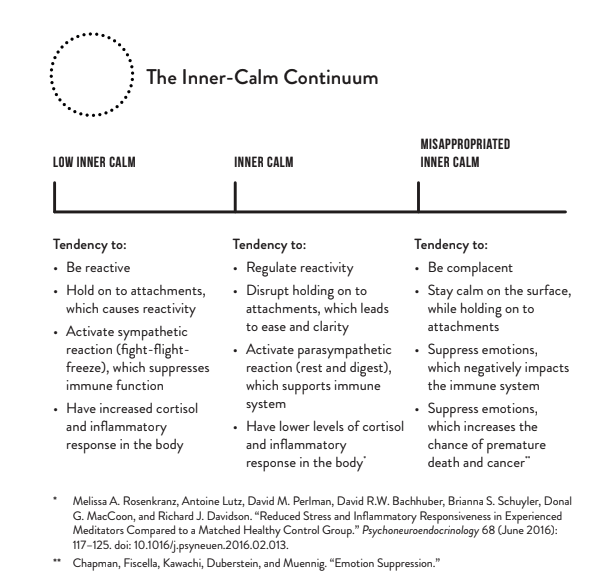
Measuring Progress: The Inner Calm Continuum and Continuous Development
Individuals can actively strengthen their capacity for inner calm regardless of their current circumstances. The journey begins with heightened self-awareness: paying attention to moments of calm versus agitation, and identifying the specific causes and conditions that either promote or hinder tranquility. By systematically cultivating habits that soothe the mind and body, individuals can progressively enhance their ability to access this state of inner stillness more quickly and easily. This is not a destination but a continuous process of learning, adapting, and refining one’s internal landscape.
The integration of inner calm practices into daily life represents a significant paradigm shift, moving from a reactive stance to a proactive one in managing mental and emotional well-being. It underscores a growing understanding that true fulfillment, effective leadership, and positive global impact are intrinsically linked to an individual’s capacity to return to mindfulness and disrupt default habits of reactivity. As our world continues to present unprecedented challenges, the cultivation of inner calm stands as an indispensable skill, empowering individuals to navigate complexity with grace, clarity, and enduring resilience.