 admin
admin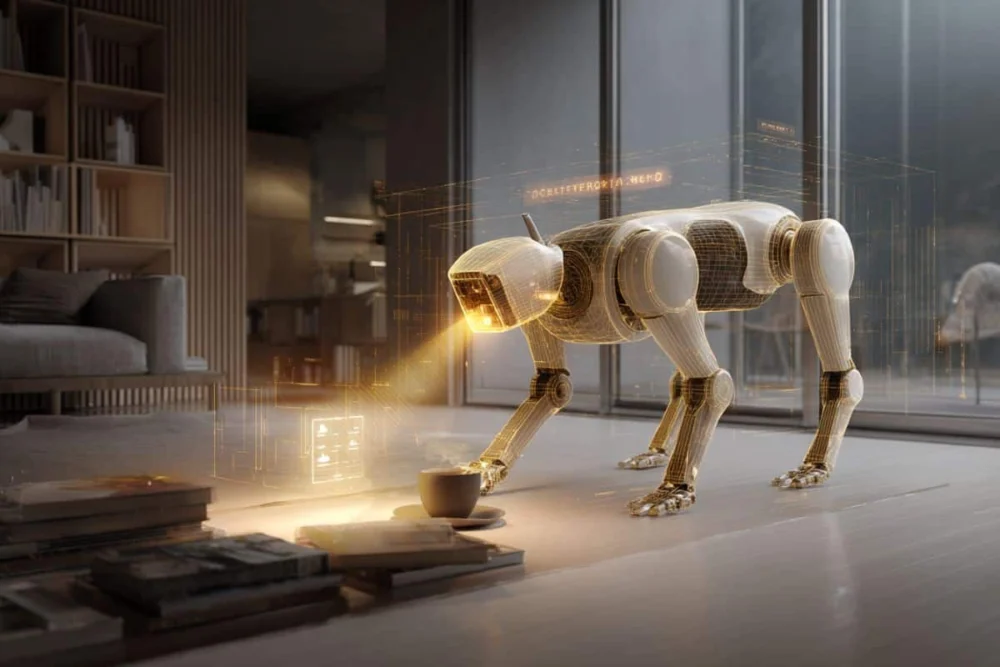
For decades, the seemingly simple human command to "fetch" an object has represented a formidable computational challenge for autonomous robots. Navigating a cluttered environment, discerning a specific item amidst a myriad of distractions, and interpreting vague human directives like pointing or general descriptions have collectively formed a significant hurdle in the quest for truly intuitive human-robot interaction (HRI). However, a groundbreaking development from Brown University researchers is poised to transform this landscape, drawing an unlikely but profoundly effective inspiration from the animal kingdom’s undisputed champions of retrieval: dogs. By meticulously studying how canines interpret human pointing gestures and gaze, a team of scientists has engineered an innovative AI framework, dubbed LEGS-POMDP, which significantly enhances a robot’s ability to locate and retrieve specific objects with unprecedented accuracy.
This pioneering system, which intelligently combines natural language processing with sophisticated interpretation of physical gestures, demonstrated an impressive 89% success rate in laboratory tests. This performance dramatically surpasses the capabilities of previous systems that rely solely on verbal commands or isolated visual cues, marking a pivotal advancement in making robots more adept and reliable assistants in both domestic and industrial settings. The findings of this landmark study are scheduled to be presented on Tuesday, March 17, at the International Conference on Human-Robot Interaction (HRI) in Edinburgh, Scotland, promising to reshape expectations for future robotic autonomy and collaboration.
The Enduring Challenge of Robot Fetch: A Computational Quandary
The seemingly effortless act of retrieving an item is, for humans, a fundamental aspect of daily life and social interaction. Yet, for a robot, this task is an intricate dance of perception, cognition, and action, laden with layers of uncertainty. Traditional robotic systems often struggle with what researchers term "the ambiguity problem." A command like "get the mug" can be ambiguous if multiple mugs are present, or if the desired mug is partially obscured. Similarly, a simple pointing gesture can be imprecise, especially in a dynamic or visually complex environment. Robots, lacking the intuitive contextual understanding that humans and even some animals possess, have historically relied on meticulously programmed rules or extensive datasets, which fall short in real-world scenarios characterized by clutter, variability, and nuanced human communication.
The computational demands for a robot to accurately identify and retrieve an object are immense. It requires advanced computer vision to process visual data, natural language processing (NLP) to understand verbal instructions, and sophisticated spatial reasoning to navigate and interact with its environment. Moreover, the robot must contend with "partial observability"—the reality that it rarely has a complete or perfect understanding of its surroundings. Objects might be hidden, lighting conditions can change, or the target item might simply look similar to other objects. These factors contribute to a "computational nightmare," leading to errors, delays, and a significant barrier to the widespread adoption of versatile robotic assistants.
Canine Cognition: An Unconventional Blueprint for AI
The breakthrough from Brown University stems from an unconventional source of inspiration: the profound cooperative abilities of domestic dogs. For millennia, dogs have co-evolved with humans, developing an extraordinary capacity to interpret human social cues, including pointing gestures and eye gaze. This unique interspecies communication skill makes dogs unparalleled "world champions of fetch." Recognizing this inherent aptitude, researchers at Brown, particularly drawing on the expertise from Associate Professor of Cognitive and Psychological Sciences Daphna Buchsbaum’s laboratory, sought to reverse-engineer this canine understanding into an artificial intelligence framework.
The "Brown Dog Lab" has extensively studied the subtleties of canine-human interaction, observing how dogs seamlessly integrate visual information from human body language with their understanding of verbal commands. This research highlighted that dogs don’t just follow the direction of a pointing finger; they integrate information from the human’s eye gaze, head orientation, and even body posture to infer the intended target. This holistic interpretation allows them to disambiguate human communication, even when it is imprecise or context-dependent. It became clear to the Brown team that if robots could learn to interpret human cues with a similar level of sophistication, their ability to execute tasks like object retrieval would drastically improve.
The LEGS-POMDP Framework: A Multimodal Leap Forward
The core of this innovative approach is the LEGS-POMDP framework. LEGS stands for Language, Eye-gaze, Gesture, and Spatial reasoning, embodying the multimodal inputs the system processes. POMDP, or Partially Observable Markov Decision Process, is a mathematical framework that empowers a robot to reason and make decisions under uncertainty. Unlike simpler decision-making models, a POMDP enables a robot to continuously update its beliefs about the state of the world based on new observations, even when those observations are incomplete or ambiguous. This allows the robot to choose actions that not only advance its primary goal (e.g., finding an object) but also actions that reduce its uncertainty (e.g., moving to get a better view, or examining an object from a different angle).
The innovation here lies in how the LEGS-POMDP integrates diverse inputs into this probabilistic reasoning engine. Lead author Ivy He, a graduate student at Brown, along with Ph.D. student Madeline Pelgrim, conducted detailed studies into the nuances of human pointing, building on the insights from the Brown Dog Lab. They discovered that humans intuitively align their eye gaze with their pointing gestures. This observation allowed them to model the target of a pointing gesture not as a single, precise point, but as a "cone of probability" extending from the human’s eye to their elbow and wrist. This probabilistic cone captures the inherent ambiguity of human pointing while still providing the robot with a highly informed spatial clue.
This gesture model was then combined with a Vision-Language Model (VLM). VLMs are sophisticated AI systems trained on vast datasets of images and corresponding textual descriptions, enabling them to understand the semantic content of visual scenes in conjunction with natural language commands. For instance, a VLM can understand that "red mug" refers to a specific type of object with certain visual attributes. By fusing the VLM’s linguistic and visual understanding with the dog-inspired probabilistic gesture model, the LEGS-POMDP framework provides the robot with a rich, multimodal understanding of the user’s intent. "Our work in the Brown Dog Lab has shown just how sophisticated dogs are in their communication with humans, solving many of the cooperation problems we want robots to solve," explained Professor Buchsbaum. "This makes them a natural model for intuitive human-non-human cooperation. This work translates the dog’s intuitive understanding of human gaze and pointing into a probabilistic model, which allows the robot to handle the ambiguity inherent in human communication. It moves us closer to truly intuitive robotic assistants."
Rigorous Testing and Remarkable Results
To validate the efficacy of the LEGS-POMDP framework, researchers conducted a series of rigorous laboratory experiments. A quadruped robot, equipped with the new AI system, was tasked with locating and retrieving various objects scattered across cluttered lab spaces. These environments were designed to mimic the complexities of real-world settings, featuring partially hidden items, multiple similar objects, and varying levels of visual obstruction.
The results were compelling. The robot, leveraging the combined power of language and gesture interpretation through LEGS-POMDP, achieved an 89% success rate in correctly identifying and retrieving the target objects. This performance stands in stark contrast to systems relying solely on either verbal commands or visual cues. In previous research and comparative benchmarks, robots operating with only language input often struggled significantly in ambiguous situations, with success rates sometimes dropping below 50% in highly cluttered environments. Similarly, vision-only systems, while powerful for object recognition, frequently failed to infer the specific intent of a human user without additional contextual input. The LEGS-POMDP’s ability to fuse these diverse streams of information enabled it to navigate uncertainty, intelligently explore its environment to gather more data (e.g., by moving to get a better vantage point), and ultimately make highly confident and accurate decisions.
"Searching for things requires a robot to navigate large environments," stated Ivy He. "With current technology, robots are pretty good at identifying objects, but when the environment is cluttered, things are moving around or things are hidden by other objects, that makes things much more difficult. So this work is about using both language and gesture to help in that search task." This robust performance underscores the transformative potential of multimodal interaction for enhancing robotic utility and reliability.
Broader Implications and Future Horizons
The development of LEGS-POMDP represents more than just an incremental improvement in robot performance; it signifies a profound shift towards more natural and intuitive human-robot collaboration. The implications span across numerous sectors:
Domestic and Personal Assistance: Imagine a future where robots seamlessly assist individuals with mobility challenges, fetching items from shelves, or helping organize a home without requiring precise, pre-programmed instructions. This framework moves us closer to truly helpful home robots that understand human intent even in the messy reality of a lived-in space.
Industrial and Logistics Automation: In warehouses, factories, and workshops, robots could become invaluable assistants, retrieving specific tools, components, or materials for human workers. The ability to interpret a worker’s pointing gesture and verbal description could dramatically increase efficiency and reduce errors in complex assembly lines or inventory management. The global industrial robotics market, already valued in tens of billions, stands to benefit immensely from such enhanced capabilities, driving further automation and productivity gains.
Healthcare and Emergency Services: In critical environments like hospitals, robots could assist nurses or doctors by fetching specific medical instruments or supplies, minimizing human movement and potential contamination. In search and rescue operations, robots equipped with LEGS-POMDP could more accurately identify and retrieve objects of interest, potentially saving lives by rapidly locating critical items in disaster zones.
Enhanced Accessibility: For individuals with disabilities, robots that can understand natural, imprecise commands could unlock new levels of independence and support, making daily tasks more manageable and accessible.
This research aligns with a broader trend in AI and robotics towards "embodied AI," where intelligent systems learn and operate within the physical world, interacting with humans and objects in a manner akin to biological entities. The success of LEGS-POMDP highlights the power of interdisciplinary research, bridging cognitive science (understanding human and animal behavior) with computer science (developing advanced AI algorithms). "This is a really great illustration of how we can enable more natural and effective human-machine interaction by strengthening collaborations between computer science and cognitive science," noted Ellie Pavlick, an associate professor of computer science at Brown who leads ARIA, the AI Research Institute on Interaction for AI Assistants, which supported this work. "Embracing what we know about how humans naturally want to communicate, and building systems aligned with those human tendencies and intuitions about behavior, is the right way forward."
Looking ahead, the researchers envision expanding the framework to incorporate even more forms of human communication, such as eye gaze patterns, demonstrations, and even emotional cues. The goal is to create robots that can adapt to different users, learn from new interactions, and operate autonomously in increasingly complex and unpredictable environments. Jason Liu, a postdoctoral researcher at MIT and co-author on the project, emphasized this vision: "The framework we developed helps pave the way for seamless multimodal human-robot interaction. In the future, we can communicate with our assistant robots the same way people interact through language, gestures, eye gazes, demonstrations and much more."
The work was supported by significant funding from the National Science Foundation (NSF), the Long-Term Autonomy for Ground and Aquatic Robotics program, and the Office of Naval Research. These investments underscore the strategic importance of this research for advancing both fundamental AI capabilities and practical applications in defense and public service. The LEGS-POMDP framework from Brown University stands as a testament to the power of biomimicry in engineering, demonstrating that sometimes, the most sophisticated solutions to complex technological problems can be found by observing the simple, elegant intelligence evolved over millennia in the natural world.