admin
admin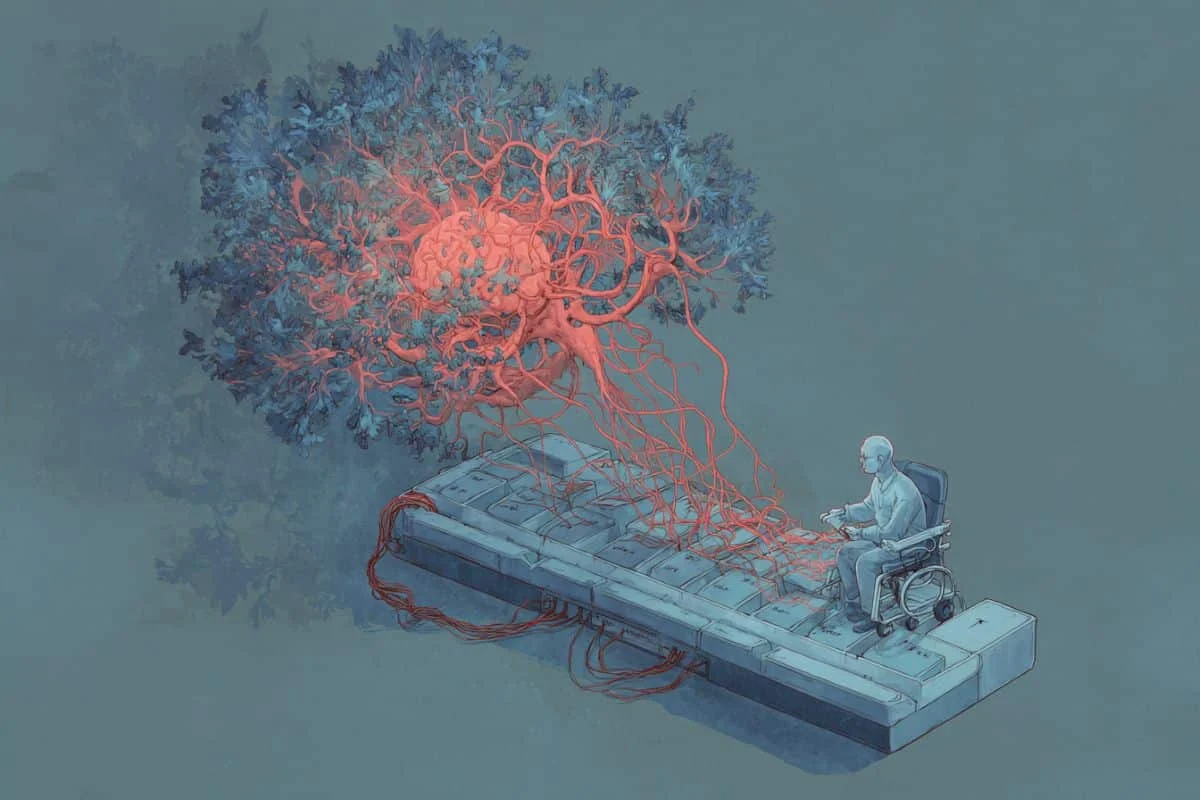
In a significant leap forward for neurotechnology, a new investigational brain-computer interface (iBCI) has demonstrated the ability to restore rapid and accurate communication for individuals suffering from severe paralysis, enabling them to type simply by attempting to move their fingers. This revolutionary system, detailed in a study by investigators from the Mass General Brigham Neuroscience Institute and Brown University, maps neural signals directly onto a virtual QWERTY keyboard, allowing participants to achieve typing speeds and accuracies comparable to able-bodied individuals. The findings, published in the esteemed journal Nature Neuroscience, offer a beacon of hope for millions worldwide who face profound losses of autonomy due to conditions like amyotrophic lateral sclerosis (ALS) and spinal cord injury.
The Devastating Impact of Communication Loss
For patients living with severe paralysis, particularly those who lose both the ability to use their hands and to speak, the inability to communicate effectively can be among the most devastating symptoms. Conditions such as ALS, a progressive neurodegenerative disease that affects nerve cells in the brain and spinal cord, gradually rob individuals of voluntary muscle control, leading to paralysis and speech impairment (dysarthria or anarthria). Similarly, high cervical spinal cord injuries can result in quadriplegia, severely limiting or eliminating the ability to move limbs and often affecting respiratory and speech functions. Globally, it is estimated that millions live with these conditions, with hundreds of thousands newly diagnosed each year. For these individuals, the world shrinks dramatically as they struggle to express basic needs, thoughts, and emotions, leading to isolation, frustration, and a diminished quality of life.
Existing augmentative and alternative communication (AAC) systems, while providing some assistance, often fall short of meeting the complex needs of these patients. Technologies like eye-gaze tracking systems, which allow users to select letters by looking at them, are a common recourse. However, as Dr. Daniel Rubin, MD, PhD, a critical care neurologist with the Center for Neurotechnology and Neurorecovery at Mass General Brigham Neuroscience Institute and senior author of the study, notes, "Those systems take far too long for many users." Patients frequently describe these tools as slow, cumbersome, and error-prone, leading to high rates of abandonment. The mental fatigue associated with meticulously selecting each letter, one by one, through eye movements can be immense, making natural, fluid conversation or sustained writing nearly impossible. This significant gap between available technology and patient needs has long underscored the urgent demand for more intuitive, faster, and more effective communication solutions.
The BrainGate Initiative: A Decade of Innovation
Addressing this critical need is the core mission of BrainGate, a pioneering consortium of neurologists, neuroscientists, engineers, computer scientists, neurosurgeons, mathematicians, and other researchers from multiple partner institutions. Since its inception in 2004, the BrainGate team has been at the forefront of advancing and testing the feasibility and efficacy of implantable brain-computer interfaces designed to restore communication and independence for people with neurological diseases, injuries, or limb loss. Their collaborative, multi-disciplinary approach has fostered an environment of innovation, pushing the boundaries of what is possible in restorative neurotechnology.
Dr. Leigh Hochberg, MD, PhD, who leads the BrainGate clinical trial and serves as director of the Center for Neurotechnology and Neurorecovery at Mass General Brigham Neuroscience Institute, emphasizes the power of this collaboration: "The BrainGate consortium demonstrates the strength of academic and university-based researchers working together, thinking about what’s possible, and then advancing the frontiers of restorative neurotechnology." He adds that such foundational research by academic institutions plays a crucial role in paving the way for industry to develop and commercialize the final forms of implantable medical devices that will ultimately benefit patients. Over nearly two decades, BrainGate has contributed significantly to the understanding of how brain signals can be harnessed to control external devices, laying the groundwork for the current breakthrough in typing neuroprosthetics. Previous BrainGate studies have explored control of robotic arms, cursor movement, and even more basic communication methods, each building upon the knowledge gained to refine the potential of BCIs.
How the Neuroprosthesis Works: Unpacking the Technology
The new BrainGate iBCI typing neuroprosthesis represents a sophisticated integration of neurosurgery, signal processing, and artificial intelligence. The system’s functionality begins with the precise surgical implantation of microelectrode sensors into the motor cortex—the region of the brain responsible for planning and executing voluntary movements. These tiny arrays of electrodes are designed to detect the subtle electrical activity, or neural spikes, generated by individual neurons within this critical brain area. Crucially, even when a person’s muscles are paralyzed, the brain’s intent to move a limb still generates these electrical signals. The brain "tries" to move, even if the body cannot respond.
Once implanted, the system leverages this innate neural activity. A standard QWERTY keyboard is presented virtually to the participant. Each key on this virtual keyboard is implicitly associated with a specific finger movement or position—for example, pressing ‘J’ might correspond to an attempted index finger movement. As the participant intuitively attempts these familiar finger movements, the implanted electrodes meticulously sense the corresponding electrical activity in the motor cortex. This raw neural data is then transmitted to an external computer system.
The computer system employs advanced algorithms to translate this complex pattern of neural activity into discrete digital commands. Essentially, it learns to recognize the unique brain signature associated with the attempted movement for each letter. This output is then fed into a sophisticated predictive language model, akin to those used in modern smartphones or word processors. This language model plays a vital role in enhancing both the speed and accuracy of communication. By anticipating likely words and correcting potential misinterpretations of neural signals, the model ensures a more cohesive and accurate communication result, significantly reducing the cognitive load on the user and improving overall throughput. This multi-layered approach, from direct neural decoding to intelligent linguistic prediction, is what elevates this iBCI beyond previous communication aids.
Clinical Trial Successes: Speed, Accuracy, and Home Use
The efficacy of this innovative neuroprosthesis was rigorously tested in two BrainGate clinical trial participants, offering compelling evidence of its transformative potential. One participant suffered from advanced ALS, a condition that progressively impairs motor function, while the other had a cervical spinal cord injury, leading to tetraplegia. Both individuals, facing profound communication challenges, utilized the new iBCI typing neuroprosthesis to communicate with remarkable speed and accuracy.
A critical aspect of the device’s user-friendliness is its rapid calibration process. Participants were able to calibrate their devices with as few as 30 sentences, demonstrating the intuitive nature of the system and its ability to quickly adapt to individual neural patterns. The results were nothing short of astonishing: one participant achieved a top typing speed of 110 characters per minute, which translates to an impressive 22 words per minute. Furthermore, this speed was accompanied by an exceptionally low word error rate of just 1.6%. To put this into perspective, these metrics are on par with the typing accuracy of many able-bodied individuals, and significantly surpass the performance of previous brain-computer interfaces designed for typing, which often struggled to achieve more than 5-10 words per minute with higher error rates.
Perhaps even more significantly for future adoption and patient independence, both participants were able to use the device from the comfort of their own residences. This successful demonstration of at-home use is a massive milestone, proving the potential for this investigational device to transition from a laboratory setting to practical, daily application in patients’ lives. The ability to communicate effectively and independently from one’s own home can dramatically enhance quality of life, fostering greater social connection, self-expression, and personal agency.
Expert Perspectives and Optimism
The research team expressed profound optimism regarding the implications of their findings. Dr. Daniel Rubin highlighted the limitations of current AAC systems, stating, "Often, people with severe speech and motor impairments end up relying on things like eye-gaze technology—spelling words out one letter at a time by using an eye movement tracking system. Those systems take far too long for many users." He emphasized that patients frequently find these systems frustrating and that BCIs are poised to become an essential new alternative.
Dr. Leigh Hochberg underscored the broader impact of the BrainGate consortium’s work, noting, "By doing so, we make it that much easier for industry to create the final form of implantable medical devices for our patients." This perspective highlights the crucial role of academic research in driving innovation that eventually translates into commercially available and widely accessible medical solutions.
Dr. Justin Jude, PhD, a postdoctoral researcher at Mass General Brigham and the first and corresponding author of the study, pointed to the multifaceted potential of the technology. "Decoding these finger movements is also a big step toward being able to restore complex reach and grasp movements for people with upper extremity paralysis," he stated. This indicates that the neural insights gained from this typing neuroprosthesis could have far-reaching applications beyond communication, potentially enabling control over advanced prosthetic limbs or other assistive devices. Dr. Jude also acknowledged avenues for further improvement, suggesting enhancements like implementing a stenography or personalized keyboard to achieve even faster typing speeds. He concluded, "Our BCI is a great example of how modern neuroscience and artificial intelligence technology can combine to create something capable of restoring communication and independence for people with paralysis."
Beyond Communication: Broader Implications for Motor Restoration
While the immediate and profound impact of this iBCI is on communication, the underlying principles and technological advancements have much broader implications for the field of neurorehabilitation. The ability to accurately decode attempted finger movements from the motor cortex provides a critical foundation for restoring more complex motor functions. The dexterity required for typing, involving subtle and rapid sequential finger movements, is a highly sophisticated motor skill. By successfully translating these neural commands, researchers are gaining invaluable insights into how the brain plans and executes fine motor control.
This understanding could directly inform the development of neuroprosthetics designed to restore complex reach and grasp movements for individuals with upper extremity paralysis. Imagine a patient with a spinal cord injury being able to mentally command a robotic arm to pick up an object, open a door, or perform other intricate tasks that require coordinated finger and hand movements. The current typing neuroprosthesis effectively acts as a stepping stone, demonstrating that the neural signals for such dexterity are present and decodable, even in the absence of physical movement. Future research will likely focus on translating these decoded finger movements into direct control of external robotic devices or functional electrical stimulation systems that could reanimate paralyzed muscles.
Addressing the Future: Challenges and Opportunities
While the current study represents a monumental achievement, the journey from an investigational device to a widely available medical solution involves navigating several challenges and seizing new opportunities.
Regulatory Pathway: The device is currently designated as "Investigational Device. Limited by Federal Law to Investigational Use." This means it is still in clinical trials and has not yet received approval from regulatory bodies like the U.S. Food and Drug Administration (FDA) for general medical use. The successful "at-home" use by participants is a significant step towards demonstrating its practicality and safety outside of a controlled lab environment, which is crucial for regulatory approval. The next phases will likely involve larger clinical trials, further proving long-term safety, reliability, and efficacy across a more diverse patient population. The FDA’s pathway for novel neurotechnologies is evolving, and close collaboration between researchers, industry, and regulators will be essential to streamline the approval process.
Technological Advancements: The researchers themselves point to avenues for further refinement. Implementing personalized keyboards, potentially utilizing stenography principles or adaptive layouts based on individual typing patterns, could further boost typing speeds. The development of wireless BCI systems, reducing the need for percutaneous connections, would significantly enhance user convenience and reduce infection risks. Miniaturization of the hardware, improved battery life, and enhanced long-term stability and biocompatibility of the implanted electrodes are ongoing areas of research and development that will contribute to the device’s eventual widespread adoption. Advances in artificial intelligence and machine learning will also continue to improve the accuracy and speed of neural signal decoding and predictive language modeling.
Patient Access and Cost: As with many cutting-edge medical technologies, the eventual cost and accessibility of such an advanced iBCI will be critical considerations. The surgical implantation, specialized hardware, and ongoing technical support will likely make it an expensive intervention initially. Efforts to reduce manufacturing costs, secure insurance coverage, and establish equitable access will be vital to ensure that this transformative technology can reach all individuals who could benefit from it, not just a privileged few. Advocacy groups for conditions like ALS and spinal cord injury will play a crucial role in championing access.
Ethical Considerations: As BCIs become more sophisticated, ethical considerations surrounding privacy, autonomy, and the interface between human and machine will become increasingly prominent. Questions about data security for neural signals, the potential for "mind-reading" (though current BCIs are far from this), and the long-term psychological impact of living with an implanted device will need careful and ongoing deliberation by bioethicists, researchers, patients, and policymakers.
A New Horizon for Autonomy and Independence
The development of this high-speed, accurate typing neuroprosthesis marks a profound milestone in the quest to restore autonomy and independence for individuals living with severe paralysis. By tapping directly into the brain’s innate intention to move, the BrainGate team has engineered a system that feels intuitive and natural, bypassing the physical limitations imposed by injury or disease. This is not merely about enabling communication; it is about restoring dignity, fostering connection, and reopening avenues for self-expression, education, and engagement with the world. The ability to articulate thoughts, participate in conversations, write emails, or even pursue creative endeavors can dramatically improve mental well-being and overall quality of life. As this investigational device continues its journey through clinical development, it carries the promise of transforming the landscape of assistive communication, offering a future where the silence imposed by paralysis can finally be broken, and the human spirit’s desire to connect can once again find its voice.
Research Details and Acknowledgements:
Authorship: In addition to Daniel Rubin, Leigh Hochberg, and Justin Jude, the authors include Hadar Levi-Aharoni, Alexander J. Acosta, Shane B. Allcroft, Claire Nicolas, Bayardo E. Lacayo, Nicholas S. Card, Maitreyee Wairagkar, Alisa D. Levin, David M. Brandman, Sergey D. Stavisky, Francis R. Willett, Ziv M. Williams, and John D. Simeral.
Disclosures: CAUTION: Investigational Device. Limited by Federal Law to Investigational Use. The content is solely the responsibility of the authors and does not necessarily represent the official views of the National Institutes of Health, or the Department of Veterans Affairs, or the United States Government.
Source: Mass General
Original Research: Open access.
"Restoring rapid natural bimanual typing with a neuroprosthesis after paralysis" by Justin J. Jude, Hadar Levi-Aharoni, Alexander J. Acosta, Shane B. Allcroft, Claire Nicolas, Bayardo E. Lacayo, Nicholas S. Card, Maitreyee Wairagkar, Alisa D. Levin, David M. Brandman, Sergey D. Stavisky, Francis R. Willett, Ziv M. Williams, John D. Simeral, Leigh R. Hochberg & Daniel B. Rubin. Nature Neuroscience.
DOI: 10.1038/s41593-026-02218-y